
Board Goals Summary
Having strategic goals for your nonprofit and your board created by your board of directors can help your nonprofit stabilize, grow and serve your mission more effectively. Make those goals SMART and get staff and volunteers’ input so your board can make clear goals that take real world feedback into account. Once you’ve decided on a direction for the organization, sit down with your board to develop the goals. Then you can track your progress and adjust as needed.
Why is Strategic Planning Important for Nonprofits?
How much time does your nonprofit’s Board of Directors spend on strategizing for the year ahead? Based on a study conducted by Bridges Business Consultancy, 48 percent of leaders spend less than one day per month discussing strategy. Interestingly enough, 48 percent of organizations also fail to meet their annual targets.
It can be easy to let the seemingly never-ending tasks of today get in the way of a board’s ability to set goals for tomorrow. Though addressing immediate needs of your nonprofit is important, it is essential to the longevity of your organization to keep your eyes on the prize: providing consistent, sustainable services and programs to your community. The best way to consistently achieve your board goals is by implementing strategic planning. The objective of strategic planning is to think about where your organization wants to go long-term, the ways it will get there, and how to determine if your charity or foundation has met the mark.
What are the Benefits of Strategic Planning?
- Sets Clear Board Goals: Requires you to think of both long-term and short-term goals
- Creates Effective and Efficient Decision-Making: Encourages your board to consider alternatives and make choices that support your long-term goals
- Encourages Proactive Policies: Allows your board to plan ahead instead of reacting to a challenge in fight-or-flight mode
- Strengthens Team Engagement and Alignment: Provides an opportunity for all voices of the organization to be heard while preventing mission creep
- Ensures Risk Management: Involves identifying and controlling potential threats to your mission into the goal-setting process
- Establishes Accountability: Develops a culture of honesty, transparency with your staff, and individual responsibilities that work toward your overarching board goals
What Do Clear Board Goals and Organizational Goals Look Like?
Organization-Wide Goals
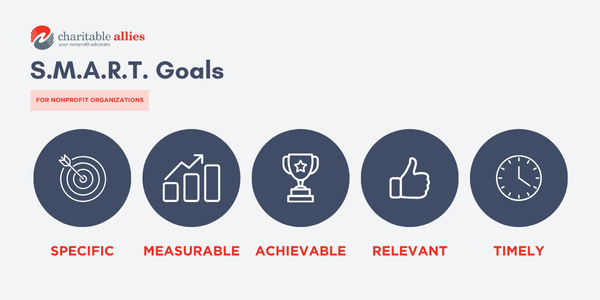
When your board thinks about setting goals for your charity or foundation, it may feel overwhelming. There are probably countless ideas that swirl around in your minds about what services you want to offer, how you want to fundraise, etc. and that’s great! However, you want to focus on goals that are SMART: Specific, Measurable, Achievable, Relevant, and Timely. This keeps your board goals within reach while also working towards your overarching mission. It is helpful to focus on one main goal for the year, with sub-goals that work towards that main goal over time. Your main goal may not feel SMART, and that’s okay. You want to aim big when establishing long-term goals. By creating short-term SMART goals, you have a way to evaluate what success at a bigger scale looks like.
For example:
MAIN GOAL: Nonprofit A wants to reach stability
SMART GOALS:
- Have $20k in savings by the end of the year
- Improve efficiency of Program A, lowering costs by 10%
- Raise additional $50k in funds
- Improve staff retention, lowering turnover by 10% this year
In this example, the main goal is broad and open-ended. There are many ways that your nonprofit could define “stability”, and means something different to every organization, whether you’ve just earned your exempt status, or if you’ve been operating for 20+ years. In the same way, there are several ways that you can reach this goal. The SMART goals listed are just four examples. The most important thing to notice about these goals is that they are setting a clear objective, and there is an easy way to determine whether or not the goals have been met.
Internal Board Goals
In addition to establishing goals for your organization, it’s equally important for the board to set goals for itself. These board-specific goals focus on improving governance, engagement, and overall board performance. For example, your board might want to:
- Increase board member participation in committees or special projects
- Strengthen diversity on the board
- Complete an annual board self-assessment
- Provide training in key areas like fundraising, legal compliance, or financial oversight
- Improve communication and collaboration between board and staff
- Develop a clear process for onboarding and mentoring new board members
Questions to Guide Board Goal-Setting
As your board works toward its own goals, asking the right questions can help set priorities, improve accountability, and strengthen your understanding of what your board does well, and what needs improvement. Consider discussing questions like:
- Are there any existing barriers that prevent board members from engaging actively in committees or meetings?
- Does our board reflect the diversity and perspectives of the community we serve?
- Are our meetings focused on overall impact or mostly internal operations?
- What training or development opportunities would help board members lead with greater confidence and knowledge?
- What specialized knowledge or skill sets are missing from our board?
- How can we improve collaboration and communication between the board, staff, and new members?
Setting goals and asking questions about the strengths and weaknesses of your board helps board members hold themselves accountable, identify areas for growth, and ensure they are effectively supporting the organization’s mission. A board that invests in its own development not only models strong leadership but also strengthens the foundation of the nonprofit as a whole.
How Does Strategic Planning Help Achieve Board Goals?
You can properly allocate your resources.
If your organization receives a large unexpected donation, your board may reevaluate your short-term goal by taking your current resources into account. Conversely, consider your organization not being awarded a government grant that you were counting on for the year. The strategic planning process emphasizes forecasting the implications of both outcomes and ensuring your goals can still be met. It encourages the organization to improvise and get creative with the ways you are fundraising so you can still work towards reaching your goal at the end of the year.
You can implement proactive policies.
Strategic planning makes your board aware of the internal and external roadblocks to success and provides the ability to plan ahead. Going back to the example of not receiving a government grant: Awareness of this being a potential roadblock to completing your goal encourages you to come up with other ideas for fundraising before you are notified of not receiving the grant. In order to proactively plan, use the concept referred to as the “Vanishing Options Test” in Decisive written by New York Times Bestselling authors Chip and Dan Heath. In the Vanishing Options Test, you ask yourself: If you couldn’t choose your Plan A, what would you do? By considering more broad options at the forefront of your plan, it preps you for the worst-case scenarios (and the best!).
Your staff and volunteers can be involved.
Implementing strategic planning also encourages engagement and regular participation from not only the leaders of the organization, but the staff, volunteers, and other stakeholders in the organization. While formal meetings of the board are essential, less formal conversations with the individuals that conduct the everyday activities can provide valuable insight to whether or not the goals being set are practical, or if there are other more feasible ways to achieve them. Having set board goals also motivates more of the public to become volunteers for your nonprofit, as it can provide a true sense of contribution to your mission and accomplishment of your goal.
How can Strategic Planning Make a Nonprofit More Resilient?
You will automatically take future issues into account.
Taking a look at potential threats to achieving your goals (both long-term and short-term), understanding how to address them, and having a plan in place for the “what ifs” in place, you will be better prepared when issues do come up.
Issues from the outside world that can affect your nonprofit may include:
- Regulatory and legislative changes (State or federal law changes, IRS regulations, etc.)
- Nonprofits providing similar services to yours or different services that serve the same population
- Natural disasters
- Shifts in your community (Changing public sentiment, current local events, etc.)
- Economic booms or recessions
Issues that can stem from the inside of your organization may include:
- Volunteer incidents (exposure to potential harm like an animal bite when volunteering at a shelter)
- Conflicts of interest (more on the IRS’ definition of conflicts of interest here)
- Staff misconduct
- Insufficient policies that lead to crisis (like not having financial policies followed leading to fraud)
Address potential realistic threats to your mission through the strategic planning process. Accounting for the ‘worst case scenario’ while setting goals requires your board to account for risk from the very beginning of the process.
If you would like more legal guidance on determining and addressing potential threats to your nonprofit’s success, read this article on board liability, or take a look at our Board Management Packets for more in depth guidance.
How Do I Implement a Strategic Plan for My Nonprofit?
So how do you actually put your strategic plan into action? Of course, there is no one specific way to create a strategic plan. Some organizations utilize a five-step plan, others implement seven steps. It involves trial and error to determine what works best for your board. However, the three core steps to implement into your goal strategy are developing the plan, executing the plan, and adapting & adjusting the plan.
Developing the Plan
-
- Establishing specific responsibilities and accountability within your board
- Scheduling general deadlines to meet milestones
- Determining the specific initiatives to achieve each objective
- Becoming aware of the risks/roadblocks to success
- Getting input from staff and volunteers (though you don’t have to accept and agree with all input you get)
- Meeting with your board to put the board goals and strategic plan in writing
Executing the Plan
-
- Allocating funds, staff and volunteer efforts, and other resources to completing objectives
- Communicating regularly to evaluate progress and challenges (including updating the board and updating the staff/volunteers)
- Establishing practical metrics to track progress over time
- Adding checkpoints, such as a quarterly check-in, to see if you are on track and evaluate if course correction is needed.
Adapting and Adjusting the Plan
- Being open to changes in the plan and using trial-and-error to find what works
- Analyzing why goals were (or weren’t) reached and how you can emulate (or change) that in the coming years
- Adjusting to key changes like cuts in grant funding or unexpected events like natural disasters
- Discussing with key stakeholders like staff, volunteers, partners, etc. how to improve in later years
Board Goals and Next Steps
Your nonprofit can implement ongoing, goal-oriented strategic planning by focusing on SMART goals and proactive policies. In the process, establish check-ins to track your progress and adjust as needed. Educate staff and volunteers on board goals so everyone is on the same page. By embedding long-term strategy and goals into your everyday work and choices, your organization can better navigate challenges and deliver sustainable impact to your community.
At Charitable Allies, we are dedicated to helping your charity or foundation achieve your goals and thrive. Throughout your journey developing a strategic plan, you may find that you need help with various aspects including board compliance, legal guidance with fundraising and contracts, minimizing risk, and board conflicts. We are here to help you navigate it all, so we also offer various levels of Board Management Packages. From providing documents that help you run your board effectively and efficiently, to hands-on attorney time with your board, we hope to meet your organization where you’re at and take you where you want to go.
Further Suggested Reading
Prosper Strategies – Types of Strategic Planning
Decisive: How to Make Better Choices in Life and Work – Chip and Dan Health, 2013