
Key Takeaways:
- Nonprofits must stay on top of core compliance requirements — including IRS Form 990 filings, state annual reports, and charitable registrations — to protect their tax-exempt status and credibility.
- Missed filings or outdated internal documents can lead to penalties, loss of good standing, revoked tax-exempt status, and damage to donor trust.
- Compliance for nonprofit organizations becomes manageable with simple, shared systems like calendars, checklists, and clear ownership (instead of relying on one person’s memory).
- Automating, delegating, or outsourcing complex tasks allows nonprofit leaders to reduce risk, avoid burnout, and stay focused on advancing their mission.
No one starts a nonprofit because they love compliance. But missed filings and overlooked nonprofit compliance requirements can quickly create real risk, from financial penalties to losing your tax-exempt status or donor trust.
The good news? Compliance doesn’t have to feel chaotic. Here’s what you really need to know, how to make it manageable, and when it makes sense to ask for help.
The Core IRS and State Requirements You Can’t Ignore
Whether you’re a scrappy all-volunteer group or a growing organization with full-time staff, the list of annual compliance tasks doesn’t change. Every nonprofit has to keep up with the basics:
IRS Form 990 filing requirements
Your Form 990 (or 990-EZ or 990-N) is your annual financial disclosure, and one of the most important nonprofit IRS filing requirements. It’s how you show the IRS — and the public — that your work supports a charitable purpose. The version you file depends on your organization’s size:
- Form 990-N (e-Postcard): For very small nonprofits with normally $50,000 or less in annual gross receipts. This is a simple online filing confirming basic organizational information.
- Form 990-EZ: For organizations with gross receipts under $200,000 and total assets under $500,000. This requires summary financial data, program descriptions, and basic governance information.
- Form 990 (long form): Required if gross receipts are $200,000 or more, or total assets are $500,000 or more. This version includes detailed financial reporting, compensation disclosures, and governance questions.
Skipping your filing has serious consequences. If you fail to file for three consecutive years, the IRS will automatically revoke your tax-exempt status. Filing the correct version each year protects your 501(c)(3) status and reinforces your credibility with funders.
State annual reports
Most states require nonprofits incorporated in that state to file an annual report to remain in good standing. This filing typically goes to your state’s Secretary of State (or similar agency). It’s usually a straightforward form confirming that your organization is still active. You may need to:
- Update your mailing address.
- Confirm or update officers and directors.
- Verify your registered agent (a physical in-state contact for legal notices).
- Pay a filing fee.
It’s not a financial disclosure like Form 990. Think of it as the state’s way of asking, “Are you still operating, and are your records up to date?” If you don’t file, your nonprofit can lose its good standing with the state, making it harder to update records, change leadership, or conduct official business.
Charitable registration
If you want to solicit donations in a state, you may need to register as a charitable organization there. The key word is soliciting. It’s not about where your organization is headquartered, or even where you’re sending the request from. It’s about where the donor is located when you ask for the contribution. For example, if you send email appeals from California to supporters who live in Nevada, you need to register in both California and Nevada.
Solicitation can include:
- Online donation pages.
- Email campaigns.
- Social media fundraising.
- Direct mail.
- Grant applications.
- Event registration fees.
Raising a small amount in a state doesn’t automatically trigger penalties, but assuming you’re exempt can create compliance gaps. Late filings may result in fines, and failure to register can damage credibility with donors and the public.
Internal policy updates and board governance
Then, there are bylaws, conflict-of-interest policies, and whistleblower policies. These aren’t “set it and forget it” documents. Over time, organizations evolve, and outdated policies might not reflect how decisions actually get made. You may need to review and update your governance documents if:
- You’ve gone through a merger, fiscal sponsorship change, or major restructuring.
- Your board roles or leadership structure have shifted.
- You’ve added new programs or revenue streams.
- You find yourselves regularly bending or missing parts of your bylaws.
- New board members seem confused about authority or decision-making processes.
Regular board reviews help prevent misunderstandings, confusion around authority, and awkward moments when a crisis exposes gaps no one realized were there.
Building Systems That Make Compliance Sustainable
If your current system is “We try to remember,” you’re not alone. Many organizations rely on institutional memory — until someone leaves, roles shift, or life gets busy. Compliance becomes far more manageable when it lives outside any one person’s head and inside simple, shared systems.
Start with a compliance calendar, where you can set deadline reminders and assign clear ownership. Pair that with a shared folder that holds past filings, templates, and policies, so no one is digging through old inboxes when a question comes up.
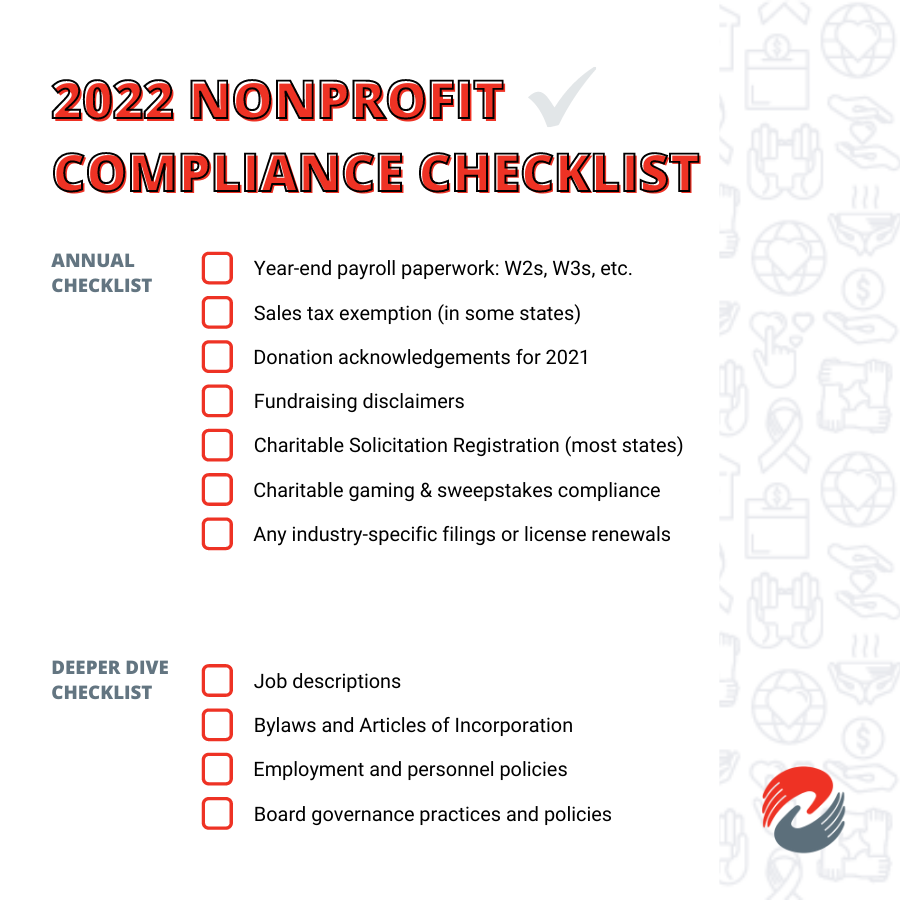
A practical way to organize that system is through a clear, recurring checklist.
Nonprofit Compliance Checklist
Annual tasks:
- Complete Form 990.
- Submit state corporate filings.
- Renew charitable registration.
Quarterly or periodic tasks:
- Review financial reports.
- Revisit and document any program changes that affect your filings.
Ongoing tasks:
- Keep board minutes organized and accessible.
- Confirm donor acknowledgment letters were sent.
- Track donations and grants with required documentation.
- Log in-kind gifts, volunteer hours (if applicable), and restricted funds accurately.
Every few years (or after major organizational changes):
- Review board policies.
- Conduct a comprehensive bylaws review.
- Update governance documents to reflect current board structure or leadership changes.
- Add or revise safety, risk management, or operational policies as needed.
What You Can Automate, Delegate, or Outsource
You don’t need to be a compliance superhero. In fact, trying to do it all yourself is a fast track to burnout and missing important tasks. Here’s a better way to think about it:
Automate:
- Use calendar tools or software to send filing reminders.
- Set up acknowledgment letters or donation receipts to go out automatically.
- Use cloud storage to keep policies, minutes, and reports organized.
Delegate:
- Assign a board member to review governance documents.
- Divide up registration renewals if you fundraise in multiple states.
- Have one staff member own the compliance calendar and update it quarterly.
Outsource:
Some parts of compliance for nonprofit organizations really do benefit from legal support, especially if you’re expanding, restructuring, or unsure how to document a particular activity. Tasks like drafting bylaws, reviewing policies, or handling multistate registrations can be handled by nonprofit compliance services like Charitable Allies, so your staff can focus on the mission.
Outsourcing doesn’t mean you’re not capable. It means you’re being smart with your time and energy.
Avoiding the Bottlenecks That Slow Everything Down
Compliance issues rarely come from one big mistake. More often, they build quietly through small, very human breakdowns:
The “one-person system”
If just one person holds all the compliance knowledge (and they leave, get sick, or go on vacation), everything stalls. Create shared systems and document key responsibilities to keep momentum going.
The “I’ll get to it later” spiral
It’s easy to let nonurgent filings slide until they pile up and feel overwhelming. Setting earlier internal deadlines can help take the pressure off.
The “handoff hiccup”
When new board members or staff step in, they may not know what’s due or when. Baking compliance into onboarding prevents dropped balls and awkward surprises.
How Smart Compliance Supports Your Mission
Compliance isn’t just paperwork. When done well, it’s part of your organization’s stability. It helps your team:
- Stay eligible for grants and donations.
- Avoid surprise penalties or rushed catch-up filings.
- Show funders and donors that your organization is trustworthy and well-run.
- Transition leadership smoothly.
A strong nonprofit compliance checklist helps protect your status and gives your people the confidence to focus on the work (instead of worrying about what might go wrong behind the scenes).
Where Charitable Allies Fits In
Charitable Allies works with nonprofits of all sizes to make compliance less overwhelming and more manageable. Whether you need help with nonprofit annual filings or internal policy updates, our team can step in with the kind of support that fits unique needs.
Our nonprofit compliance services include:
- Filing assistance for IRS and state forms.
- Board training on governance roles and responsibilities.
- Policy reviews to keep your internal docs up to date.
- Ongoing legal advisory, so you have a steady guide when questions pop up.
You don’t have to figure this out on your own. Let us help you create a compliance system that keeps you focused on what matters: your mission, your people, and your impact.

- What is a Nonprofit Legal Health Check? | With Examples & Preview - October 12, 2026
- Understanding the Updated 2026 IRS Group Exemption Rules: A Guide for Nonprofits - September 11, 2026
- When You Should Create a 509a3 Nonprofit Supporting Organization? - July 24, 2026