Key Takeaways:
-
Three missed 990s in a row means automatic revocation, even if your organization raised $0.
Many new nonprofit leaders start with a cause they care about and learn the legal and financial requirements one problem at a time. Most of those problems are avoidable with a little planning in the first year.
In this episode of 501c Suite, Olivia Froedge, COO of Charitable Allies is joined by Will Gay, Nonprofit Compliance Coordinator, to break down four mistakes we see often in a nonprofit’s first few years and what to do instead.
A cause can matter a great deal and still not need a brand new organization. Before you file anything with the state, look closely at the community you want to serve and answer three questions:
- Who is already doing this work specifically?
- Who already serves this population? How many organizations serve this population in the city? In the county? In the state?
- Which organizations do adjacent work and could be partners?
We think of this as stewardship. If five organizations in your county already run food pantries, a sixth will compete with them for the same volunteers, grants, and donors. You may help more people by volunteering with one of them, joining its board, joining its staff or running your program under an existing organization through fiscal sponsorship.
If the scan shows a specific need nobody is meeting, you come away with evidence you can use in grant applications and donor conversations, and with a clear picture of the population you’ll serve. Either way, it’s a win.
Do the community scan first. A needs assessment tells you who you’ll serve, who else is serving them, and where your work can add value.
Most new nonprofits begin with a broad vision: help local children, support families, improve animal welfare, serve the elderly. That vision gives the organization its purpose, but it can’t tell the board how much to raise this year or when the program has worked.
In a year from now, what would you consider a success? Is it helping one family? Ten? Fifty?
Olivia and Will recommend SMART goals. Here’s how each piece applies to one example goal, “provide backpacks and school supplies to 100 preschoolers before the start of the next school year”:
- Specific: names who you’ll serve (preschoolers) and what they’ll receive (a stocked backpack)
- Measurable: sets a number you can count (100)
- Achievable: fits the volunteers and money you can realistically gather
- Relevant: connects to your mission of school readiness
- Time-bound: sets a deadline (the first day of school)
A goal like that turns into a plan quickly. If a stocked backpack costs $40, you know you need to raise $4,000, recruit enough volunteers to pack 100 bags, and set a date to order supplies. When the hundredth backpack goes out, the board has a milestone to celebrate and a result to report to donors.
SMART goals help most in the early years, when one person or small group of people is often juggling the whole mission. Once you know exactly who you’re serving and what success looks like, decisions about staffing, programs, fundraising targets, and expenses get much easier to make.
Many new leaders assume the legal work is mostly finished once the IRS approves the organization. But that’s not entirely true.
Many people are familiar with the basic startup steps:
- File articles of incorporation with your state. This creates the nonprofit corporation.
- Adopt corporate documents like bylaws and a conflict of interest policy. These govern how your board operates, and the IRS looks for them when it reviews your exemption application.
- Apply for 501(c)(3) recognition on Form 1023-EZ or the full Form 1023. The 1023-EZ is shorter and costs $275, compared with $600 for the full 1023. It’s generally available to organizations that expect gross receipts of $50,000 or less in each of their next three years, have $250,000 or less in total assets, and aren’t in an excluded category such as churches, schools, or hospitals. Everyone else files the full 1023.
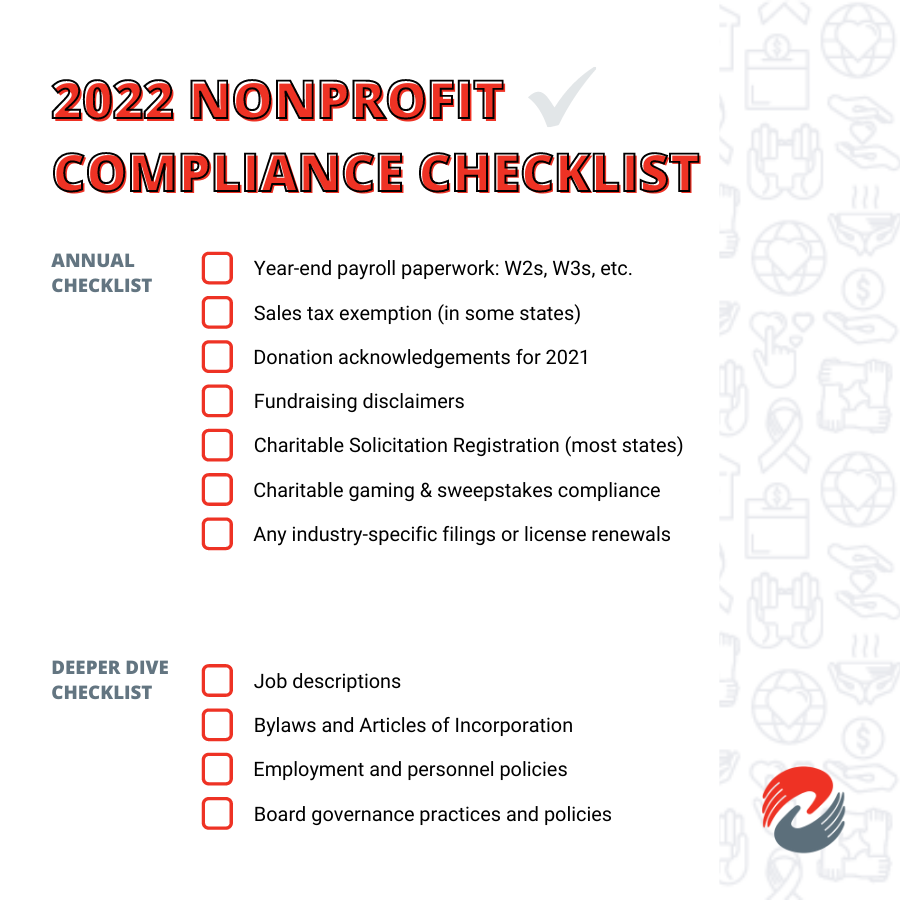
But after your initial startup paperwork, you’ll need to keep up with these three things annually:
- An annual report to the state where you’re incorporated
- An annual Form 990 to the IRS
- Charitable solicitation registration in states you’re fundraising in that require it
You’ll also want to keep in step with your bylaws, as they are legally binding and guide how the nonprofit runs at a high level. And be sure to send out donation acknowledgements to donors.
These small tasks are where many nonprofits get tripped up. They treat compliance as a setup task, and then a deadline passes without anyone noticing. But this can lead to expensive clean ups and fines. Maintaining your nonprofit isn’t difficult, but does require attention to the little deadlines throughout the year.
Tax-exempt does not mean you don’t have to file with the IRS every year. All nonprofits file some version of the 990 every year, including years when they brought in little or no money. The version depends on size:
- Form 990-N (e-Postcard): gross receipts of $50,000 or less
- Form 990-EZ: gross receipts under $200,000 and total assets under $500,000
- Form 990: gross receipts of $200,000 or more, or total assets of $500,000 or more
- Form 990-PF: private foundations, regardless of size
If a nonprofit fails to file for three consecutive years, the IRS automatically revokes its tax-exempt status. A calendar-year organization that skips its 2023, 2024, and 2025 returns loses its exemption as of May 15, 2026, the due date of the third missed return. This rule catches more organizations than most leaders expect, often after a board transition when nobody knows the filing is theirs.
The 990-N often takes less than 10 minutes for a non-accountant to complete and file online on the IRS website. The 990 often does need an accountant involved to properly complete and file it. The 990-EZ is the middle ground. It’s more complex than a 990-N, but less than the 990.
The 990 is due on the 15th day of the fifth month after your fiscal year ends. For a calendar fiscal year, that’s May 15. If your fiscal year ends June 30, it’s November 15.
Put the deadline on a shared calendar from your first year, with at least two board members on the reminder.
Many states require a nonprofit to register before you can legally ask for donations. We have a full article on CSR here, but some common examples that count as fundraising in most states include:
- Throwing an in-person fundraising event like a gala, bake sale, etc.
- Emails or texts asking people to give
- Online fundraising campaigns
- Asking people for donations from their company
State rules vary. Some states have revenue thresholds or exemptions for small organizations, and others don’t. If you’re only asking for donation from people in your state, you’re likely fine to stick with that one state’s rules. But if you have a large email list, for example, and you know that half your list lives in NY while the other half live in NJ, you’ll likely want to do both New York and New Jersey’s requirements.
You don’t need to register in every state on day one. Start with your home state and any state where you actively ask for gifts, and revisit the list as your fundraising grows.
Messy books cause problems everywhere else. They make the 990 harder to prepare, budgets less reliable, and board oversight harder to do well. If an organization ever loses its status, missing records can also rule out retroactive reinstatement, which requires back-filing every missed 990.
Bookkeeping doesn’t have to be fancy to be useful. Will’s advice is to keep a running record of:
- Donations and other revenue
- Expenses
- Assets, such as cash, equipment, and property
- Liabilities, such as loans and unpaid bills
A spreadsheet works for a small organization, as long as it’s kept up during the year and not rebuilt from bank statements the week before the deadline.
You can save time by setting up expense categories that match the Form 990. The full 990 sorts expenses into categories like program services, legal services, and fundraising, so tagging each expense that way as it’s paid gives your preparer most of what they need.
Make sure more than one person can see the accounts. A treasurer who reviews the monthly bank statement, prepared by someone else, catches errors early, and the organization isn’t stuck if the one person who knows the books steps away. Having a two-touch financial system can also help protect your nonprofit from fraud, embezzlement and theft. Even if you trust the person doing your books, having another person on financial matters keeps things secure and can keep the ball rolling if anyone is sick or on vacation.
New nonprofit leaders don’t need to know everything on day one. If you aren’t sure where your organization stands right now, the IRS Tax Exempt Organization Search will show whether your status is active and which 990s are on record. It takes about five minutes, and it’s a good place to start before your next board meeting.
If you’re looking for reliable answers to your nonprofit’s most important legal questions, visit charitableallies.org for free resources, guides, and case studies designed to support nonprofit sustainability.
Subscribe to 501c Suite so you never miss an episode, and share it with a fellow nonprofit leader or board member who could use a trusted legal ally.

- New Nonprofit Compliance Basics: 990 Filings, SMART Goals, and Staying Tax-Exempt - November 9, 2026
- How Do I Start a 501c3 Nonprofit Organization? (with Video) - June 15, 2026
- What is a Professional Employer Organization for Nonprofits?: Handling Benefits Compliance and Multi-State Payroll for Nonprofits - June 4, 2026