
Key Takeaways:
- Starting a nonprofit legally usually involves four parts: incorporating at the state level, preparing core corporate documents, filing for federal tax-exempt status, and, in many states, registering for charitable solicitation before fundraising.
- One of the most common early mistakes is forming the organization as an LLC or for-profit corporation at the state level instead of a nonprofit corporation. That can block or delay 501(c)(3) approval.
- Your core startup documents matter. New nonprofits typically need bylaws, a conflict of interest policy, an EIN, and organizational actions that approve key first steps like opening a bank account and appointing officers.
- For most new 501(c)(3) organizations, the IRS filing choice comes down to Form 1023 or Form 1023-EZ. The right option depends largely on expected revenue and the type of organization you are forming.
- In many states, you are not legally ready to fundraise just because you incorporated or filed with the IRS. Charitable solicitation registration may be required before you ask for donations.
Starting a nonprofit can be more confusing than you expect. Many founders begin with a strong mission and a clear community need, but not a clear picture of the legal process. They know they want to make an impact. They are less sure what needs to be filed, in what order, and what mistakes could create problems later.
In this episode of 501c Suite, Olivia Cloer walks through how to start a nonprofit legally in practical, plain language. She breaks the process into a few core steps, explains what each one does, and highlights the mistakes that most often slow founders down.
The overall message is reassuring: starting a nonprofit does not need to feel like rocket science. But it does require doing the legal setup in the right sequence.
Step One: Incorporate as a Nonprofit Corporation
The first legal step is forming the organization at the state level.
That means creating a nonprofit corporation, not an LLC, and not a standard for-profit corporation. Olivia flags this as one of the most common startup mistakes. If founders accidentally form an LLC or another for-profit entity and later apply for 501(c)(3) status, the IRS may reject the application because the legal entity was not organized as a nonprofit in the first place.
Founders should also know that they usually need at least three board members, including themselves, to move forward with the initial legal paperwork.
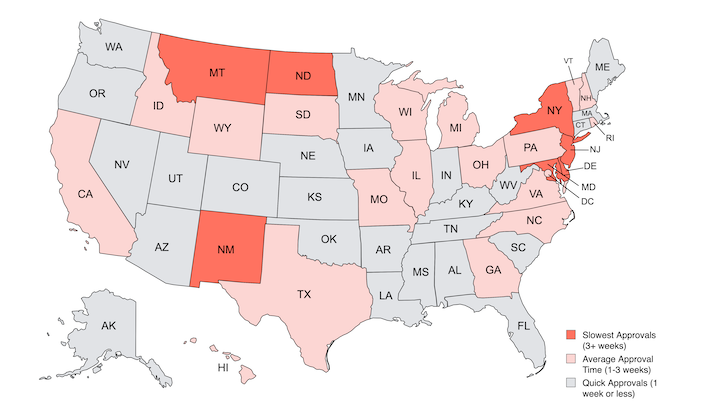
This first filing is generally one of the simpler and cheaper parts of the process. Filing fees vary by state, but Olivia explains that most fall somewhere in the $30 to $100 range, though some states are lower and some are higher. Approval timelines also vary by state. Some may turn filings around in a few days, while others can take several weeks. Below is a map of the filing times our team has experienced in each state.
The important point is that incorporation is only the beginning. At this stage, the organization exists at the state level, but it is not yet federally tax-exempt.
Step Two: Prepare the Corporate Documents
Once the nonprofit corporation is formed, founders need the core documents that prepare the organization for tax-exempt status and actual operation.
Olivia groups these together as the second step, even though they include several separate pieces.
Bylaws
Bylaws explain how the organization will run. They are not a mission statement or a program description. Instead, they cover governance: board structure, officer roles, voting rules, board terms, and practical issues like the fiscal year.
This is one of the most important foundational documents because it shapes how the organization will make decisions and stay accountable. You can listen to our episode on bylaws to learn more.
Conflict of Interest Policy
A conflict of interest policy helps the board recognize and manage situations where personal relationships or financial interests could affect decision-making.
For example, if a founder wants to become the nonprofit’s first paid executive director, and that founder’s spouse is on the board, the spouse should not vote on compensation. The policy creates a framework for handling those situations properly.
EIN
The EIN, or Employer Identification Number, is issued by the IRS and functions like the organization’s tax ID number. It is typically free and relatively quick to obtain.
A nonprofit needs an EIN to do basic things like:
- Open a bank account
- Hire employees
- Accept donations
- File with the IRS
One practical reminder from the episode stands out here: do not accept donations into a personal bank account, personal Venmo, or similar personal platform. New nonprofits need separate organizational banking as early as possible.
Organizational Actions
Organizational actions are the approvals made in the first board meeting. These often include appointing officers, authorizing someone to open a bank account, and formally approving the startup documents.
This step may sound administrative, but it matters. It helps prove that the board, not just one founder informally, is authorizing the organization’s early decisions.
Extra Step for International Work
If the nonprofit plans to operate internationally, Olivia notes that an additional policy may be needed: an OFAC compliance policy. This addresses how U.S. nonprofits must follow federal restrictions when working in other countries or with foreign partners. We discuss more about nonprofits doing work internationally in this free resource for nonprofits.
Step Three: Apply for 501(c)(3) Tax-Exempt Status
This is the part most founders know by name: filing for federal tax exemption.
Olivia explains that many people say 501(c)(3) as shorthand for tax-exempt status, but there are different kinds of tax-exempt organizations. For most charitable nonprofits, 501(c)(3) is the right category. Curious about the benefits of 501(c)(3) status? We detail the benefits of tax exempt status here.
For 501(c)(3) organizations, the IRS generally uses two forms:
Form 1023-EZ
This shorter version is often available to smaller organizations expecting under $50,000 in annual gross receipts during the first three years.
It is:
- Shorter
- Simpler
- Cheaper
- Usually faster
Olivia notes that the filing fee is $275, and approval often comes faster than the full application.
Form 1023
This is the full application and is required for some organizations regardless of size, including churches, hospitals, and schools. It is also required for organizations expecting more than $50,000 in annual gross receipts during the first three years.
It asks for more detail about:
- Budget
- Activities
- Leadership
- How money will be used
The filing fee is $600, and the review process usually takes longer.
One helpful point from the episode: if a founder makes a good-faith estimate and later brings in more money than expected, that does not automatically create a problem. The organization generally reports the change through its annual IRS filings. What matters is making a reasonable estimate at the outset.
Step Four: Register to Fundraise
Many founders assume that once they incorporate and file for tax exemption, they are ready to ask for donations everywhere.
Not necessarily.
In many states, nonprofits must complete charitable solicitation registration before they legally fundraise. This is sometimes called CSR, fundraising registration, or charity registration.
This requirement can apply not only where the nonprofit is based, but also in states where it is soliciting donors. That may include outreach by:
- Social media
- Donation campaigns
- Online fundraising pages
Some states are more explicit than others about how online fundraising counts, and internet-related rules are still evolving. But the practical takeaway is simple: if you plan to raise money in a state, check that state’s registration rules first.
Olivia notes that some states do not require this step, but many do. For new organizations, filing fees are often relatively modest, especially when the organization has raised little or no money yet.
Can You Do This Yourself?
Olivia’s answer is balanced: it depends.
A founder starting a small, straightforward charitable organization in one state may be able to handle the process alone, especially with good educational resources.
But outside help may make sense when:
- The nonprofit is more complex.
- The IRS category is less straightforward.
- The founder expects larger revenue early on.
- The organization is doing international or unusual work.
- The founder simply does not have time to manage the filings carefully.
The bigger the organization or the more complicated the mission, the more valuable legal review is.
One Final Myth to Clear Up
Olivia closes with a common question: Can you convert an LLC into a nonprofit?
Usually, no.
In most states, there is no simple process for converting an LLC into a nonprofit corporation in a way that accomplishes the founder’s charitable startup goal. In many cases, the practical path is to close the LLC and form the nonprofit correctly from the start. Read more about this process here.
Learn More and Stay Connected
If you’re looking for reliable answers to your nonprofit’s most important legal questions, visit charitableallies.org for free resources, guides, and case studies designed to support nonprofits.
Subscribe to 501c Suite so you never miss an episode, and share it with a fellow nonprofit leader or board member who could use a trusted legal ally.

CEO at Charitable Allies
As the CEO, Olivia Cloer leads the Charitable Allies team in serving over 2,000 nonprofit organizations nationwide. With previous experience as the COO and the Director of Marketing and Operations, Olivia led marketing, operations and automation efforts that led to the organization doubling in size within 3 years. Olivia joined the Charitable Allies team in 2020 after her last role serving as the Director of Development for a nonprofit. She has a passion for bringing business savvy to the nonprofit sector so they can serve great causes more effectively. She holds a Bachelor's Degree in English and Communications from DePauw University. She is also a Mitch Daniels Leadership Fellow and a Certified Salesforce Administrator.
Latest posts by Olivia Cloer (see all)