
Remote work changed how nonprofits hire.
In a recent survey, it is estimated that more than 50% of nonprofits now offer remote work options, either hybrid or fully remote. That shift has created opportunities for nonprofits to access more specialized talent. But It also introduced a level of payroll, HR, and benefits complexity many nonprofits were never built to manage.
The Hidden Risk Behind Remote Hiring for Nonprofits
What often starts as a simple hiring decision – adding one remote employee in another state – can trigger a cascade of compliance that extends far beyond issuing a paycheck and having a basic employee handbook.
For nonprofits operating with lean administrative teams, the risk of getting it wrong can be big. Payroll and HR compliance failures can lead to hefty fines, legal risk, and damage to your nonprofit’s reputation.
So what are the risks to consider when hiring remote employees for nonprofits? What is a professional employer organization for nonprofits and how do they help? And ultimately, what can nonprofits do if they don’t have time and additional staff to put towards complicated payroll and HR requirements?
Payroll for Nonprofits: Compliance Requirements Many Don’t Know
Many nonprofit leaders assume payroll compliance is largely federal, and that payroll software handles most of the complexity automatically. But that’s not true. Payroll for nonprofits can be far more complex than hitting a few buttons in your payroll software.
Each state has its own requirements for employment compliance.
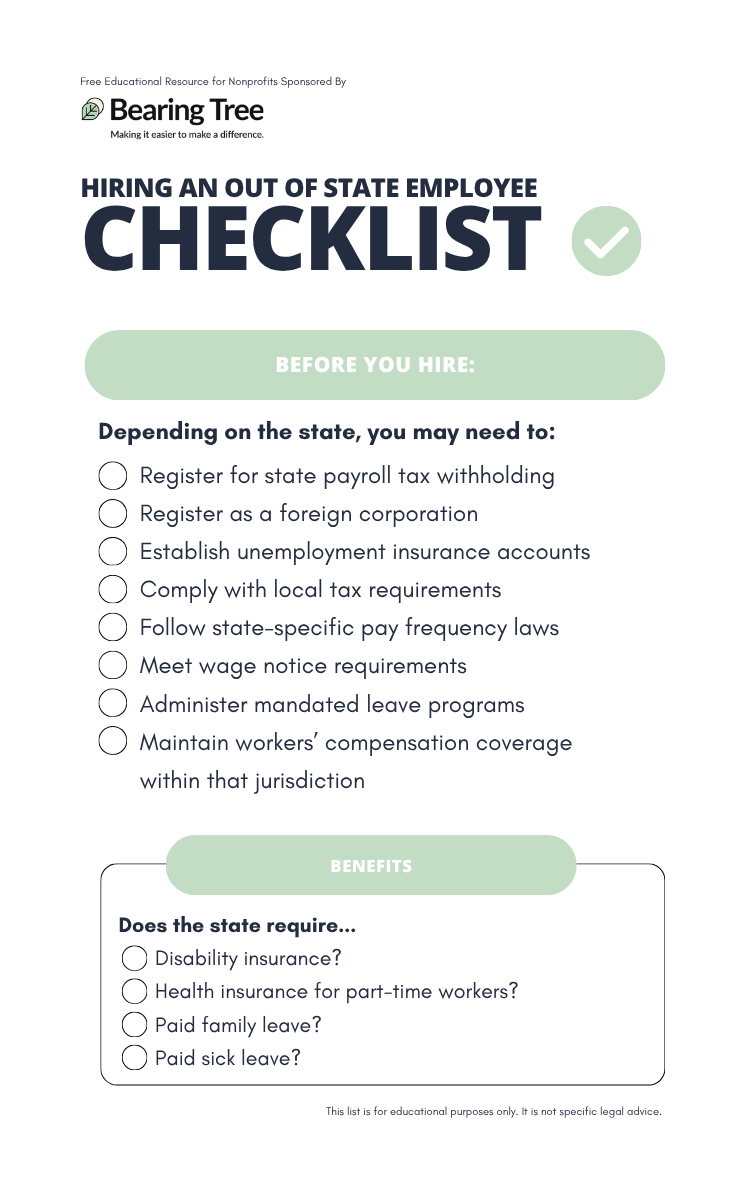
The moment an employee begins working in a new state, the nonprofit may need to:
- Register for state payroll tax withholding
- Register as a foreign corporation
- Establish unemployment insurance accounts
- Comply with local tax requirements
- Follow state-specific pay frequency laws
- Meet wage notice requirements
- Administer mandated leave programs
- Maintain workers’ compensation coverage within that jurisdiction
Those responsibilities don’t begin six months later when HR catches up administratively. They start immediately.
The problem is that compliance obligations compound with every additional state.
A nonprofit with employees in five states is not managing one set of rules. It’s navigating five different regulatory environments all at once. And those rules change constantly.
Keeping pace requires ongoing monitoring and specialized expertise that many nonprofits simply don’t have.
When Benefits Management Becomes More Complicated Than Payroll for Nonprofits
Payroll for nonprofits isn’t the only concern. Each state also has its own rules when it comes to benefits.
A benefits package that works well for employees in Illinois may create compliance gaps for employees in California, Massachusetts, Colorado, or New York. Certain states require disability insurance programs or paid family leave contributions. Continuation requirements, employee notices, and leave administration rules differ widely across jurisdictions.
At the same time, nonprofits are competing for talent. A lack of good health insurance, retirement benefits, responsive HR support, and consistent onboarding can lead to trouble with hiring and retaining employees.
Meeting those expectations across multiple states requires infrastructure that many charitable organizations lack.
Compliance Problems Often Stay Invisible Until There’s a Crisis
One of the most dangerous aspects of payroll and HR compliance is that problems frequently remain hidden until an audit, employee complaint, or legal dispute exposes them.
An organization may not realize:
- Payroll taxes were filed incorrectly
- A state registration was never completed
- Required leave notices were never issued
- Workers’ compensation coverage was incomplete
- Final paycheck rules were violated
- Local tax withholding obligations were missed
Until:
- A state agency sends a notice
- An employee or former board member files a complaint
- A tax audit begins
- A terminated employee challenges payroll practices
At that point, the cost to correct the issue is far larger than the cost to manage the compliance would’ve been.
What could’ve been prevented becomes a time-consuming, expensive distraction that consumes your attention and puts your nonprofit at risk.
What could have been prevented through proper systems and oversight becomes a time-consuming operational distraction that consumes leadership attention, strains finances, and creates unnecessary organizational risk.
For nonprofits focused on mission, these situations can be particularly disruptive. As multi-state complexity grows, many nonprofits are discovering that payroll software alone is not enough. They’re turning to a Professional Employer Organization (PEO).
Real-World Example: How Compliance Gaps Occur
A large national nonprofit organization believed its payroll vendor was fully managing multi-state payroll compliance responsibilities as the organization expanded its remote workforce to 9 different states.
Like many nonprofits, leadership assumed that when employees were hired in new states, the appropriate payroll tax accounts, unemployment registrations, and wage reporting requirements were being established and maintained behind the scenes.
But when they turned to a Professional Employer Organization (PEO), the PEO discovered several significant compliance gaps. In certain states where employees had already been working, required payroll tax accounts had never been established. In other instances, quarterly wage reports had not been filed properly, resulting in penalties and interest accumulating without leadership realizing it. Their biggest frustration was that many of the penalties would have been avoidable or recoverable had the reporting issues been identified earlier.
Importantly, these problems did not occur because the organization lacked sophistication or intentionally ignored compliance obligations. The nonprofit was well-established and had already invested in payroll administration support.
The issue stemmed from a common misunderstanding that payroll processing and payroll compliance oversight are the same thing. In reality, many payroll vendors process payroll transactions efficiently while leaving portions of compliance ownership, monitoring, and state registration responsibilities with the employer. Now, a PEO provides full payroll and benefits support to this nonprofit organization.
What is a Professional Employer Organization For Nonprofits?

A Professional Employer Organization for nonprofits is a company that provides outsourced core HR functions through a co-employer relationship. So what is a co-employer relationship?
A co-employer relationship involves a legal agreement for two organizations to have responsibility over the same employee, in this case, the nonprofit and the Professional Employer Organization (PEO). The contract determines the exact terms, but usually, the PEO is responsible for the payroll, benefits and HR compliance of that employee while the nonprofit continues to manage the employee day-to-day. There are several benefits to this co-employer arrangement.
A common example? Insurance companies often offer large group pricing to PEOs that the nonprofit (no matter its size) can tap into. Because the employee is considered an employee of the PEO as well, they gain access to high quality health insurance at a lower rate than the nonprofit could offer on its own.
What are the Benefits of Using A Professional Employer Organization For Nonprofits?
According to research findings in 2024, organizations using a PEO have a turnover rate that is 12% lower than their peers and a growth rate that is twice as high. They’re also 50% less likely to go out of business. Why?
Professional Employer Organizations help nonprofits manage payroll administration, benefits, HR operations, and compliance responsibilities through a more centralized infrastructure. Simply put, employees have a better experience and the organization thrives without the fees and headaches of getting HR and payroll compliance wrong. And for nonprofits, this means fewer pricey cleanups and more money put towards your cause.
A common misconception is that the biggest advantage is administrative convenience. But a PEOs’ risk reduction is far more valuable in the long run– saving the nonprofit thousands in fines, legal fees, and administrative headaches.
A Professional Employer Organization for nonprofits can navigate:
- Multi-state payroll administration
- Payroll tax filings and reporting
- Benefits compliance
- Workers’ compensation management
- Leave administration requirements
- Employee onboarding and offboarding
- Ongoing labor law changes
For nonprofit leaders and boards, this creates greater operational stability while reducing the likelihood that critical compliance obligations fall through the cracks. PEOs can offer peace of mind for nonprofit leaders whose plates are already full.
Real-World Example: Prevent Compliance Problems with a PEO
The leadership of a national nonprofit organization made a decision to build scalable operational infrastructure from the beginning. Even before hiring their first employee, the organization recognized that managing payroll, HR compliance, and multi-state employment requirements internally would quickly become overwhelming as they expanded.
Rather than waiting until a challenge emerged, the nonprofit partnered with a PEO early on to establish compliant payroll and employment processes from day one. This allowed leadership to focus their time and energy on launching programs, building donor relationships, and expanding their mission rather than navigating complex employment regulations across multiple states.
Since then, the organization has grown from a single employee to 26 employees working across 14 states. Throughout that growth, the nonprofit avoided many of the common administrative burdens and compliance gaps organizations often encounter during rapid expansion. State payroll tax registrations, unemployment accounts, wage reporting requirements, and ongoing compliance monitoring were handled proactively as new employees were hired in additional states.
By putting the right operational structure in place early, the organization was able to scale confidently without the delays, penalties, or administrative disruptions that frequently occur when compliance infrastructure is built reactively. Leadership maintained focus on organizational growth and mission impact rather than spending valuable time untangling payroll and registration issues after the fact.
Their PEO isn’t a one-and-done. It’s an ongoing relationship that continues to support the nonprofit as it grows, providing ongoing guidance and operational support to help leadership navigate expansion with confidence.
When is it Time to Consider if a PEO Could Be Right for Your Nonprofit?
If your nonprofit is growing, your requirements and complexity likely is as well. Administrative complexity tends to outpace leadership expectations. So when is it time to consider a Professional Employer Organization for your nonprofit?
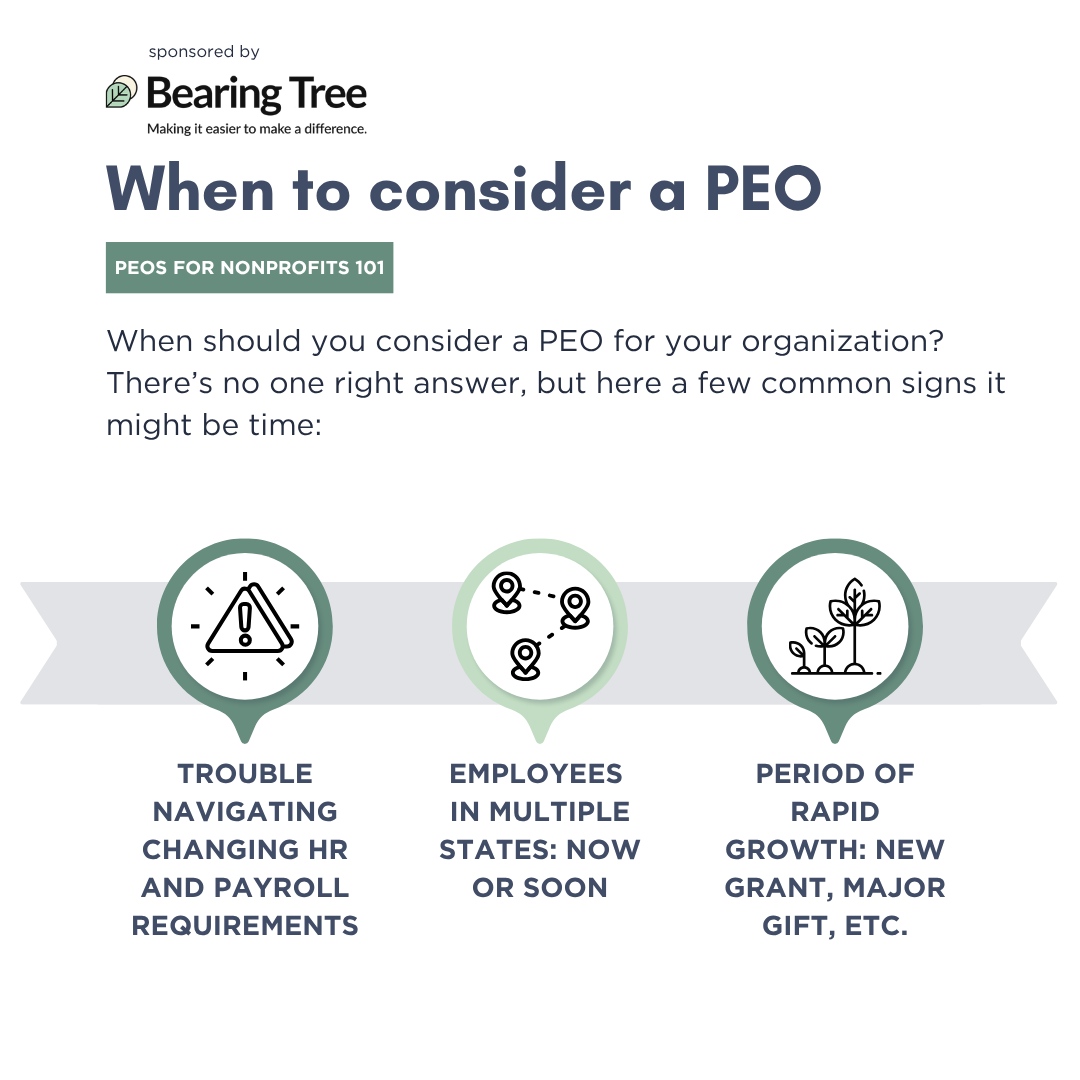
Here are three signs it might be time:
- You’re ready to offload the administrative burden and risk of keeping up with ever-changing employment and payroll regulations.
- Your nonprofit currently employs people in multiple states or is preparing to.
- You’re accepting a new grant or increased funding soon that will cause your nonprofit (and your compliance headaches) to grow.
Without the right infrastructure, organizations can quickly find themselves reacting to compliance problems instead of managing them strategically. That’s why many nonprofits are reevaluating how they support payroll, HR, benefits administration, and overall workforce management as remote work becomes permanent. A PEO allows organizations to maintain full leadership control over their mission, culture, and staff, while gaining access to deeper HR, payroll, benefits, compliance, and operational infrastructure.
A PEO allows nonprofits to maintain control over mission, culture & staff while gaining access to HR, payroll, benefits, compliance and operational expertise.
A PEO allows organizations to maintain full leadership control over their mission, culture, and staff, while gaining access to deeper HR, payroll, benefits, compliance, and operational infrastructure.
In practice, nonprofits are not left navigating complex multi-state employment regulations, payroll tax filings, workers’ compensation administration, benefits compliance, onboarding, leave management, and HR policy changes alone. Instead, they gain an experienced partner whose systems, expertise, and administrative support are designed specifically around the operational realities nonprofits face.
For nonprofit leaders and boards, the value of a PEO relationship is no longer simply administrative convenience.
It’s organizational protection.
A Note about our Sponsor
Bearing Tree partners exclusively with mission-aligned nonprofits as a Professional Employer Organization (PEO), operating through a co-employer relationship that allows organizations to maintain full leadership control over their mission, culture, and staff, while gaining access to deeper HR, payroll, benefits, compliance, and operational infrastructure.
Beyond serving as a Professional Employer Organization, Bearing Tree helps nonprofits build the operational foundation for sustainable growth through advanced, tech-enabled Finance & Accounting, Development Operations & Donor Intelligence, Board Administration & Compliance, and IT Support & Cybersecurity. These integrated services help mission-driven organizations strengthen their infrastructure, improve efficiency, and build the operational capacity needed for long-term growth and impact.