
If your organization is part of a group tax exemption, or you are considering obtaining group tax exemption in the future, the new IRS rules could impact you. Understanding the changes can help you determine what your organization needs to do to qualify for and maintain tax-exempt status as a group exemption.
A group exemption at its core involves a “parent” or “central” nonprofit organization that has multiple other nonprofits (usually called subordinate organizations) nested under the same exemption. Group exemption is different than fiscal sponsorship. Group exemptions often look like chapter or branches of the same (or very similar) nonprofit, whereas fiscal sponsorship often has more distinction between the sponsor and sponsee.

IRS Group Exemptions Before 2020
The group tax exemption program was put in place by the IRS over 40 years ago, governed by Revenue Procedure 80-27. This rule allowed a “central” or “parent” organization to share its tax-exempt status with affiliated branches or chapters.
Back in 2020, the IRS decided that the rules for this system were unclear and had become too complicated and time-consuming for the IRS to manage. Many group exemptions had multiple exemption letters and there was no formal way for group exemptions to accurately file updated information for their local branches. So, in May 2020, they temporarily stopped accepting new group exemption applications while they worked on updating the rules. The IRS didn’t start accepting new group exemption applications again until January 2026. So, for several years, organizations that wanted to use this process basically had to wait until the IRS brought the program back.
Updated January 2026 Guidelines
New guidelines for group exemptions arrived in January 2026 in the form of Revenue Procedure 2026-8, which replaced the old Rev. Proc. 80-27. The main addition to the procedure for group exemptions is an increased reporting responsibility for both the subordinate and central organizations. Under the old rules, the central nonprofit simply had to include the subordinate organizations on its annual Form 990 and maintain an updated list of those organizations. Each subordinate organization would then file its own separate Form 990 with the IRS to report its financial information.
The IRS has also included specific requirements that you’ll want to follow in order to qualify for a group exemption: affiliation and general supervision OR control. While these were requirements in the old rule, the new rule now has specific definitions and what needs to be done in order for organizations to qualify for a group exemption. These three requirements, and how to meet them, are discussed in detail below. We aim to make the updated IRS rules clear for nonprofit leaders, but if you would like the help of a nonprofit attorney to create or manage a group exemption, request a free consultation with our legal team who work exclusively with nonprofit organizations.
First, let’s go over the new filing and reporting requirements in order to obtain and continue a group tax exemption.
What are the New Group Tax Exemption Filing Requirements?
First, the IRS is now requiring that all subordinate nonprofit organizations have their own separate Employer Identification Numbers (EINs). While this was a common practice before, it wasn’t required. Some subordinate organizations just used the central nonprofit’s EINs, leading to inconsistent reporting. Subordinate organizations still do not need to incorporate at the state level. The IRS is also requiring the central organization to have at least five subordinate organizations in order to get a group tax exemption in the first place.
Additionally, the central organization will complete the Form 8940 application. The Form 8940 can be used to request changes in exempt status, or just to ask for a specific kind of determination from the IRS. With the new rules, now you can request group exemption status with Form 8940. Form 8940 can be filed electronically at Pay.gov along with the $3,500 filing fee to obtain the group exemption. Subordinate organizations should NOT apply separately for their own exemption.
The IRS has also updated the annual filing requirements in order to maintain a group exemption. The central nonprofit organization must submit the Annual Supplemental Group Ruling Information (“SGRI”). The SGRI asks you to:
- Submit any changes to the purpose, structure, or operations of subordinate nonprofit organizations.
- Provide a list of:
- Subordinate organizations that were removed from the group exemption
- New subordinate organizations
- Subordinate organizations whose IRS status was automatically revoked
- Submit 30–90 days before the end of the central organization’s fiscal year, essentially giving organizations a 60-day window to file.
- File electronically, not on paper.
An important note: central organizations that are churches do not have to file the SGRI. Multi-site churches are a unique bird in the nonprofit world that have more specific considerations than other multi-site nonprofits.
How Do The New Requirements Affect Existing Group Tax Exemptions?
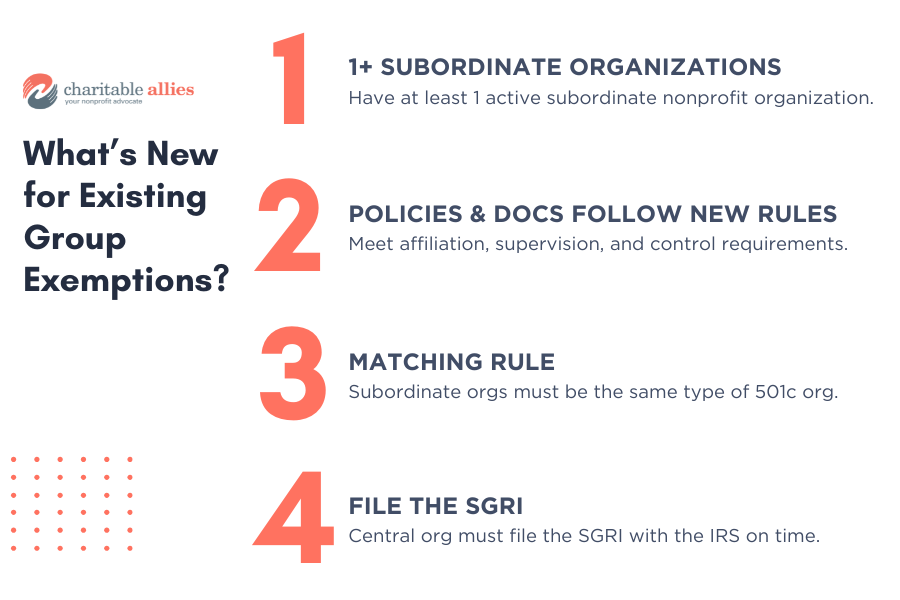
So what if you have a central or subordinate organization of an IRS group exemption that has been around long before the new requirements? The IRS set a year-long grace period for existing group exemptions to add and/or remove subordinate organizations to follow the new guidelines. January 22nd, 2027 marks the end of the transitional period to make the necessary changes before the IRS revokes tax exemption from group exemptions not following the updated guidelines. If you’re looking for assistance doing so, we’re happy to help. Schedule a consult with us to see what that process would look like.
1. Add Subordinate Nonprofit Organizations (If none exist)
First, if the central organization currently has no current subordinate organizations, the parent organization must either end operations or add at least one subordinate organization that meets the new requirements. Nonprofits that used to operate as a group exemption but no longer have any subordinate organizations will have to apply as a separate 501(c)(3) nonprofit. This includes filing Articles of Incorporation with the state the subordinate organization operates in, establishing bylaws and other internal documents, and filing a separate tax exemption application. If you’re looking for more guidance on navigating this process, schedule a free consultation with us!
2. Check that Policies and Documents Follow New Rules by January 22nd, 2027
Last, you’ll need to make sure your organization’s documents and procedures meet the affiliation, general supervision, and control requirements outlined in this article. By the end of the transition period on January 22, 2027, any subordinate organizations that do not meet these requirements will need to be removed from the group exemption. If they are not removed by that date, the central organization could risk losing its group-exempt status, which could also affect the subordinate organizations’ ability to receive tax-deductible donations.
3. Follow the Matching Requirement
All of the subordinate nonprofits covered by a group exemption must be the same type of 501(c) classification with the IRS. If an organization does not have the right 501(c) status, it must either change to the correct status or leave the group exemption. In addition to the matching requirement, all subordinate organizations of the same type (schools, churches, etc.) must have a uniform purpose statement in their governing documents.
For example, imagine a national environmental organization that is a 501(c)(3) public charity. It conducts research and publishes information about pollution and environmental conservation. Its local chapters are all 501(c)(4) organizations that focus on advocating for environmental legislation. The central organization and the local chapters do not have to be the same type. The central organization can be a 501(c)(3), while all of the local chapters are 501(c)(4)s. However, all of the local chapters must be the same type as each other.
4. File the SGRI
Central organizations must keep record and report the actions taken to ensure compliance to the IRS via their first Supplemental Group Ruling Information (SGRI) submission. Not meeting the compliance requirements by January 22nd, 2027, could result in the group exemption being terminated by the IRS, which would require every subordinate organization to apply for its own exemption
How can I remove a subordinate nonprofit from a group exemption?
To remove a subordinate organization, a central organization must provide written notice of removal and request use of any intellectual property (i.e. materials provided by the central organization, logos, use of the group’s name). The central nonprofit will then report the removal to the IRS through the SGRI.
The organization will no longer be covered by the group exemption once the removal is reported to the IRS. So if the organization still wants to be tax exempt, it will need to file its own 1023 application with the IRS. For more details on the removal process, reach out to us! We’re happy to help.
New Rules that Old Group Exemptions Don’t Need to Follow
Good news: not everything is changing for existing group exemptions! If your nonprofit is a part of an existing group exemption, you may feel overwhelmed by all the new requirements. Luckily, there are a few of the new requirements that group exemptions that existed before May of 2020 won’t need to follow.
Organization Types Grandfathered in
Type III supporting organizations and health insurance issuers described in Section 501(c)(29) that are already part of a group exemption are grandfathered in. This means they can maintain their existing group-exempt status even though the IRS no longer allows these types of organizations to join new group exemptions. However, they should still follow the new annual reporting requirements that apply to existing group exemptions.
No Uniform Purpose Statement Requirement
Subordinate nonprofit of existing group exemptions do not need to share uniform purpose statements in their organizing documents, even if the purposes are basically the same. A purpose statement is a short explanation in an organization’s founding documents that says what the organization exists to do. It’s often different than your public facing mission statement, as this is a statement in legal documents, rather than in grant applications or fundraising materials. With this rule, existing subordinate organizations do not have to go back to their founding documents and change their purpose statement if it doesn’t match.
No Removal Agreement Requirement
For existing group exemptions, there is no requirement for a written agreement allowing the central organization to remove their subordinate organizations from the group exemption with or without cause. Parent organizations are able to remove subordinate organizations without it.
What Are the Updated 2026 Requirements to Get a Group Tax Exemption?
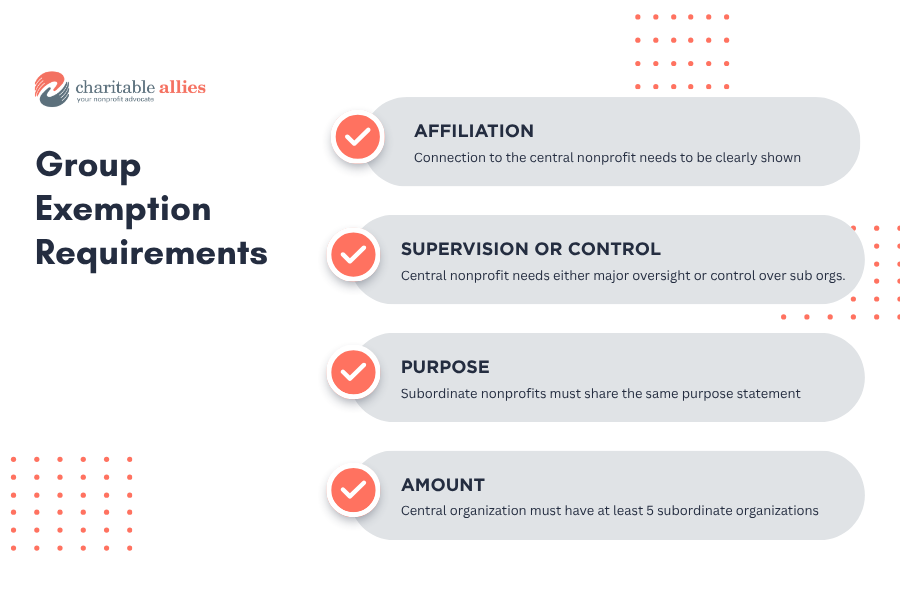
If your nonprofit is just now obtaining group exempt status here’s what you need to know: For a new group exemption, subordinate organizations must be:
- clearly affiliated with,
- generally supervised by, OR 3. controlled by the central organization.
The group must also have at least five subordinate organizations when applying, all subordinates must be the same type of 501(c) organization, and they must have matching purpose statements in their governing documents.
How to Qualify as a New IRS Group Exemption: Requirements for Subordinate Nonprofits
The biggest change to the new group exemption rules are better defined requirements of affiliation, supervision, and control. Before the new Revenue Ruling, the IRS mentioned these ideas, but left a lot of gray areas up for interpretation. In Rev. Proc. 2026-8, subordinate organizations must be affiliated and subject to general supervision and control of the central organization. Let’s break down what the IRS means by this:
Affiliated
A subordinate nonprofit’s connection to the central nonprofit organization needs to be clearly demonstrated. This can be shown in a few different ways like:
- Subordinate nonprofits using the name and logo of the central organization
- Subordinate nonprofits using the same purpose statement in governing documents for each chapter
- The central organization maintaining a formal directory on their website containing the local chapters, branches, or posts of the central organization.
Example
An example of clear affiliation is the Red Cross, which has local chapters across the country. The local chapters utilize the national organization’s name, logo, and branding, and the national organization contains a directory with all of their connected local chapters. This clearly demonstrates the local Red Cross chapters are “affiliated” with the national Red Cross organization.
General Supervision
A central organization annually obtains, reviews, and records information on the subordinate organizations’ finances, programs, and annual filing requirements. The central organization also has a responsibility to regularly provide information to the subordinate nonprofits on when they must file their annual 990 returns. Essentially, necessary information needs to flow between the central nonprofit and the chapters. There should not be financial, programmatic or compliance surprises or secrets between a parent entity and the subordinate entities.
Example
Continuing with the Red Cross example, the national organization could have quarterly meetings with their local chapters in order to provide information on their annual filing requirements and due dates, and the subordinate organizations could report their quarterly finances and planned activities to their national HQ in order to demonstrate that the national organization maintains general supervision over their local chapters. We suggest communicating regularly (at least quarterly) with subordinate chapters of your organization to ensure a healthy flow of information both ways. And at least some of that communication needs to be in writing (email, text, etc).
Control
There are several ways the central organization can demonstrate control. A subordinate organization is subject to control if:
- The central organization appoints the majority of the subordinate organization’s board of directors;
- The central organization elects the majority of the subordinate organization’s officers on the board;
- A majority of the subordinate organization’s board officers are board officers of the central organization; OR
- The central and subordinate organizations have a written agreement that shows the central organization’s control over the activities and operations of the subordinate organization.
For example, the written agreement may set up a different management structure where the central organization must approve the election of the smaller organization’s directors or can remove those directors at any time, with or without a specific reason. Another option is for the central organization to enter into a management agreement that gives it direct control over the smaller organization’s activities and day-to-day operations.
Example
Another common group exemption structure are churches with multi-site ministry/outreach organizations as their subordinate organizations. A way for the church to demonstrate control is by appointing four of the seven directors to their subordinate ministry organizations, or by creating an agreement that the ministries’ directors can be removed by the central church at any time with or without cause. Some church denominations function under group exemptions as well, with the denomination as the parent organization setting the standard for the subordinate churches within the denomination.
Other Requirements and Guidelines for Group Exemptions Created During or After 2026
1. There must be 5 subordinate organizations or more at the time of filing.
In order to obtain a group exemption letter, there must be at least five subordinate organizations under the central organization. In order to maintain the group exemption, there must be at least one subordinate organization operating under the central organization. For example, if two chapters close, and three remain, the group exemption can remain active.
2. The subordinate nonprofits all need to be the same type of 501(c) organization.
The IRS also requires that all new group exemptions meet a matching requirement. All subordinate organizations must be the same type of 501(c) organization. However, the subordinate organizations don’t have to match the parent organization.
For example, the parent organization may be a 501(c)(7) social club with five subordinate 501(c)(3) public charities.
3. All subordinate organizations must have a uniform purpose statement.
In addition to the matching requirement, all subordinate organizations must have a uniform purpose statement. In other words, each subordinate organization’s purpose statement (which is in your governing documents) must match the others.
4. The parent organization must have written authorization to remove the subordinate organization at any time for any reason.
This may sound intimidating, but this is a formalization of something that was happening in most organizations already. Essentially, the IRS newly requires a written and signed authorization stating that the parent organization has the ability to remove the subordinate organizations at any time with or without cause. It does NOT mean the parent organization must do so if there are normal disagreements between chapters or between the parent and the chapters. Having healthy disagreement and working out issues as a team is a normal part of most group exemptions.
Organizations Not Eligible for Group Exemption
The IRS has named a few organization types that are not eligible to be in a group exemption. If you’re creating a new group exemption, the group exemption cannot include:
- Private foundations
- Foreign entities (organized outside of the US)
- Type III supporting organizations
- 501(c)(29) Co-Op Health Insurance Issuers
Remember: if you have an existing group exemption that includes a Type 3 supporting organization or a 501(c)(29) Co-Op Health Insurance Issuer, you’ll likely be grandfathered in and allowed to keep group exemption status.
What is the impact of the new IRS Guidelines for Group Exemptions?
The IRS’s updated group exemption rules bring the most significant overhaul of the program in decades, placing a greater emphasis on clear oversight and accountability. While these changes create additional compliance responsibilities for both new and existing group exemptions, they also provide much-needed clarity and consistency for nonprofit organizations operating under a group exemption structure.
With the January 22, 2027 compliance deadline approaching for existing group exemptions, now is the time for central organizations to review their governance documents and procedures, evaluate subordinate organizations, and update their procedures. Taking proactive steps today can help preserve tax-exempt status and ensure your organization remains in good standing under the new rules.
If you have more questions about how these changes affect your nonprofit or need assistance navigating the transition, our legal team is here to help. Whether you need help adding or removing subordinate organizations, updating your documents to meet the new requirements, or you’re a newly organized nonprofit seeking group exemption and need help with the initial filings, we are happy to help you navigate it every step of the way.

- What is a Nonprofit Legal Health Check? | With Examples & Preview - October 12, 2026
- Understanding the Updated 2026 IRS Group Exemption Rules: A Guide for Nonprofits - September 11, 2026
- When You Should Create a 509a3 Nonprofit Supporting Organization? - July 24, 2026