
What is a Nonprofit Supporting Organization (509a3)?
A nonprofit supporting organization is a type of public charity that exists primarily to support one (or sometimes more) other nonprofit organizations. For example, a supporting organization might raise funds, manage investments, provide administrative services, or hold assets for a university, hospital, museum, religious organization, or community foundation. They help the supported nonprofit carry out its charitable mission more effectively. 509(a)(3) Supporting organizations can also conduct their own programming, but the programming must be in furtherance of the purpose of the nonprofit that is being supported. All nonprofit organizations are classified as 501(c)(3) public charities under the subcategory of 509(a)(3).
To create a nonprofit supporting organization, you must file as one with the IRS. There are three different types, depending on your nonprofit’s structure. Each has specific requirements you must meet to qualify. We’ll discuss qualifications, benefits, and each of the three types below.
What Qualifies as a 509(a)(3) Nonprofit Supporting Organization?
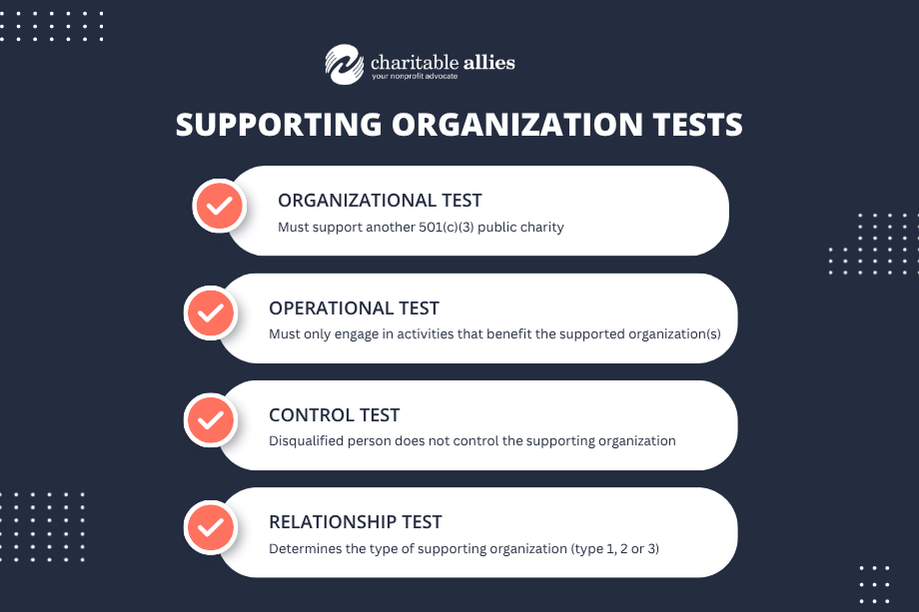
The IRS has four different tests to determine if your organization is eligible to become a 509(a)(3) nonprofit supporting organization: The organizational test, operational test, control test, and relationship test. All supporting organizations must pass each of the four tests. How you satisfy each test will determine what type you’ll be.
Organizational Test
This one is pretty straightforward, but important. The organizational test states that your nonprofit must support another organization that passes the requirements of being a 501(c)(3) charity. This includes both financial support and programmatic support. Additionally, you must state in your Articles of Incorporation that you exist to benefit the other organization’s charitable purposes, rather than conduct your own charitable activities.
Operational Test
The operational test states that you must solely conduct activities that benefit the supported organization(s). In addition to making direct grants to its supported organization, a supporting organization may make grants or provide services or facilities to:
- individual members of the charitable class benefited by its supported organization(s),
- another supporting organization that supports the same supported organization(s) or
- a state college or university described in Internal Revenue Code section 511(a)(2)(B).
The most important thing to remember is that any grants, services, or facilities must benefit the supported organization, not just the direct recipients. For example, let’s say a hospital creates a supporting organization. If the supporting organization funds new medical equipment, research programs, or family housing near the hospital, these activities clearly benefit the hospital and help it carry out its charitable purpose.
A potential problem could arise if the supporting organization starts giving scholarships to students in the community who have no connection to the hospital. The students would benefit, but the hospital does not. Because the activity does not support the hospital’s mission or operations, it may not qualify as a proper activity for a supporting organization.
Control Test
The control test states that a disqualified person must not control a supporting organization. But who counts as disqualified? Generally speaking, a disqualified person is someone who has an influential relationship with an organization. This typically includes major donors, officers, directors, or trustees. It can also include certain family members of those people, like a board chair’s spouse, for example. A disqualified person is someone who could personally benefit from the supporting organization. For more details on private benefit, inurement, and conflicts of interest, check out this previous post on our blog.
However, the IRS has a special exception on who is considered a “disqualified person” when it comes to supporting organizations. Much like other nonprofits, supporting organizations need a board of directors. Directors, officers, and trustees, who would otherwise be considered a “disqualified person”, are excluded from the definition of “disqualified person” for the purpose of the control test. Simply being on the Board of the supported organization does not prohibit you from being a part of the board of the supporting organization. In fact, depending on the type of supporting organization, it is a requirement for there to be overlap on the supported and supporting organization’s boards.
So, what does control really mean? In the eyes of the IRS, control means having the practical ability to make the organization take important action, or prohibit the organization from taking important action on its own. Overall, the IRS wants supporting organizations to ensure that they are able to make their own key decisions without the influence of people that could personally benefit. As with other types of nonprofits, if someone on the board has a potential conflict of interest, he or she should recuse themself from voting on that decision.
Example: Control by a Major Donor
John is a major donor to a supporting organization and, because of his substantial contributions, is considered a disqualified person.
The organization has a nine-member board, and John holds one seat. On paper, he does not control the organization. However, John selected five of the other directors, the board routinely follows his recommendations, and major decisions are not made without his approval. Directors also fear losing his financial support if they oppose him.
Although John lacks formal authority to make key decisions alone, he has the practical ability to direct or block significant actions. As a result, John indirectly controls the supporting organization, causing it to fail the control test.
Relationship Test
Once it is determined that your organization qualifies as a Nonprofit Supporting Organization, the Relationship Test determines what type of Supporting Organization you would be.
The Three Types of Nonprofit Supporting Organizations
Type 1 Supporting Organization
To be a Type 1 Supporting Organization, you must be operated, supervised, or controlled by the supported organization. The supported organization appoints or elects majority of directors or trustees to the supporting organization. This is commonly referred to as a parent-subsidiary relationship.
Example of a Type 1 Supporting Organization
A “Community Health Support Foundation” is organized to support the activities of the “Neighborhood Medical Clinic”. The Clinic appoints the majority of the Foundation’s directors, and has the authority to remove them. The Clinic approves the Foundation’s budget and maintains ultimate power and oversight on how resources are utilized.
Type 2 Supporting Organization
To be a Type 2, the supporting organization must be supervised or controlled in connection with its supported organization. Typically, the same people will control both organizations in tandem. Type 2 is commonly referred to as a brother-sister relationship.
Example of a Type 2 Supporting Organization
“Education Support Foundation” is created to support the “Literacy Center”. Each nonprofit has 7 directors, 4 of them are overlapping. The Literacy Center prepares an annual budget identifying staffing needs, facility expenses, and outreach initiatives, to which the Foundation adopts a grant budget that will mirror those needs.
Type 3 Supporting Organization
Type 3 organizations operate in connection with one or more publicly supported organizations. Type 3 supporting organizations have a much more independent relationship, and consequently, have more regulations and reporting requirements to function properly. Due to the complexity of Type 3’s we won’t do a deep dive on them here. If you’re looking into creating a Type 3 supporting organization, reach out to us! We’re happy to help.
Supporting Organization or Private Foundation?
At this point, you may be thinking that the purpose and goals of a supporting organization sound similar to that of a private foundation. The idea of creating a nonprofit organization to benefit another existing nonprofit is a common reason why private foundations are formed. However, when you get into the details, they’re actually quite different. The table below takes a look at the similarities, differences, benefits, and downsides of both of them.
| Feature | Supporting Organization | Private Foundation |
| Purpose | Often created by an existing nonprofit to support their own efforts | Created by independent people or groups with less specific funding priorities |
| IRS Status | Classified as a public charity by the IRS | Classified as a private foundation by the IRS |
| Public Support Test | Is not required to pass public support test; Can be funded by a small group of individuals | Is not required to pass public support test; Can be funded by a small group of individuals |
| Relationship Requirement | Must be organized to support at least one other public charity | No required relationship to another charity |
| Excise Tax on Net Investment Income | No federal excise tax on net investment income | Subject to 1.39% excise tax on net investment income |
| Self-Dealing Rules | Not subject to strict PF self-dealing rules (though excess benefit rules do apply) | Strict self-dealing prohibitions |
| Minimum Distribution Requirement | No mandatory annual payout requirement | Must distribute approximately 5% of assets annually |
| Expenditure Responsibility | Not required when granting to public charities | Required when granting to organizations not recognized as a 501(c)(3) charity |
| Tax-Deductibility Limits | Higher charitable deduction limits for donors, like all public charities | Lower charitable deduction limits for donors |
| Filing Requirements | Fewer regulatory/reporting burdens (could file the 990-N or 990-EZ depending on income) | Heavily regulated, much more detailed reporting requirements (must file 990-PF regardless of income) |
| Control Restrictions | Cannot be controlled by disqualified persons | Commonly controlled by major donors and/or family members |
Overall, nonprofit supporting organizations have less restrictions and regulations than private foundations do. The IRS generally allows more flexibility to public charities, and by becoming a supporting organization, you get to reap the benefits of that flexibility while pursuing similar goals that you would if you were to become a private foundation.
Benefits of Supporting Organizations: Why Nonprofit Leaders Create Them
Creating a 509(a)(3) supporting organization for your nonprofit is a strategic, financial and legal decision. Be sure you are consulting with experienced professionals when considering updating or changing your organizational structure. If you would like to talk with an attorney who practices nonprofit law, please schedule a consultation.
People create supporting organizations for a variety of reasons, including:
- Accepting gifts that could risk the organization failing the public support test and being reclassified as a private foundation
- Managing endowments or investments for the supported organization
- Holding real estate like a building or land
- Managing and preventing legal or financial risk (especially risk associated with an asset or program)
There are lots of intricate details that go into the benefits of creating a supporting organization for your nonprofit. If you want to talk about your specific situation, schedule a consultation with one of our attorneys. We are happy to help.
Summing Up Nonprofit Supporting Organizations
A nonprofit supporting organization can be a powerful tool when your nonprofit’s goals and funding require a more strategic structure. Whether you’re looking to formalize support for a single charity, navigate governance relationships, or protect your status under the IRS’ public support rules, this model offers a unique balance of flexibility and compliance. That said, it isn’t the right fit for every organization. Careful planning, a clear understanding of the requirements, and alignment with your long-term mission are essential to making the most of what a supporting organization can offer. If you’re looking for specific advice on if a supporting organization is right for you, feel free to reach out to us!
Further Reading
https://www.irs.gov/charities-non-profits/charitable-organizations/private-foundations
https://www.ngosource.org/an-introduction-to-supporting-organizations

- What is a Nonprofit Legal Health Check? | With Examples & Preview - October 12, 2026
- Understanding the Updated 2026 IRS Group Exemption Rules: A Guide for Nonprofits - September 11, 2026
- When You Should Create a 509a3 Nonprofit Supporting Organization? - July 24, 2026